Feature Overview: Best Vibe Coding Tools in 2026
| Provider | Starting PRICE | FREE TRIAL | PROMPT BASED | THIRD-PARTY INTEGRATION | |
|---|---|---|---|---|---|
![]() | $25.00 | Yes | Yes | Supabase, GitHub, Stripe | Visit Lovable |
![]() | $16.00 | Yes | Yes | Stripe, Zapier, Airtable | Visit Base44 |
![]() | $2.39 | Yes | Yes | Stripe, PayPal, Google Analytics | Visit Hostinger |
![]() | $20.00 | Yes | Yes | GitHub, Stripe | Visit Emergent |
What Is a Vibe Coding Tool?
These tools aren’t just for developers; they’re for anyone who wants to build without losing momentum. Whether it’s creating a startup MVP, automating enterprise workflows, or coding alongside an AI assistant, vibe coding tools focus on flow and simplicity.
Benefits and Limitations of Vibe Coding Tools
| Benefits | Limitations |
| Speed up development with AI-assisted suggestions | May lack the flexibility of traditional coding |
| Lower the entry barrier for non-technical users | Advanced projects may hit scalability limits |
| Improve creativity by removing technical roadblocks | Rely on third-party updates and ecosystems |
| Allow rapid prototyping and idea testing | Some tools are less customizable than hand-coding |
What Features Should a Top Vibe Coding Tool Include?
- AI-powered coding support to debug, generate, and optimize code.
- Drag-and-drop editors to design apps and workflows visually.
- Prompt-to-code features to turn natural language into working logic.
- Integrations with third-party services for payments, analytics, and design.
- Scalability options to handle both prototypes and production projects.
- Collaboration features to let teams build in sync.
4 Best Vibe Coding Tools in June 2026
-
Top 10 AI App Builders 2026

Lovable is a vibe coding tool for creators and entrepreneurs. By describing your idea in plain language, Lovable generates a fully functional app with sleek branding.
It’s ideal for non-technical founders who want polished results without diving into traditional coding.
Key Features
Prompt-to-app generation builds apps directly from text.
Custom branding options ensure creative freedom.
Drag-and-drop interface simplifies building.
Pre-built templates speed up creative projects.
Instant publishing delivers apps to the web or mobile.
Beautiful, professional designs
Quick app setup and publishing
Easy for non-technical users
Limited advanced logic options
Fewer integrations than competitors
More design-focused than backend-driven
-
Best AI Website Builders 2026

Base44 is designed for enterprises that want to “vibe up” their internal processes.
With AI-driven workflow automation and compliance-ready security, it’s tailored for organizations managing complex operations.
Instead of traditional coding, Base44 emphasizes building apps that streamline business logic and workflows.
Key Features
AI-powered workflow automation that simplifies internal operations.
Enterprise-grade compliance that ensures security and regulation adherence.
Deep integrations with tools like Salesforce and SAP.
Drag-and-drop workflow builder that minimizes coding.
Custom dashboards and analytics that track performance.
Built specifically for enterprise use
Strong compliance and security focus
Deep enterprise-level integrations
Higher cost for SMBs
Complex onboarding process
Overkill for simple projects
-
Best Overall Hosting 2026
-
Users Top Choice 2026
-
Most Recommended NodeJS 2026
-
Best AI App Builder 2026
-
Top 5 Europe Web Hosting 2026

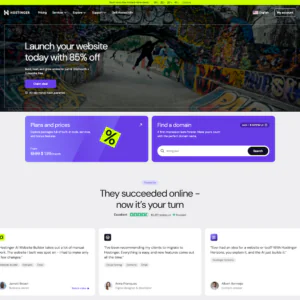
Hostinger offers Horizons, a conversational AI app builder that helps anyone create functional web applications without coding.
Users can describe their idea in plain language, and Horizons instantly generates a working app with built-in hosting, domains, and deployment included.
Unlike a traditional website builder, it focuses on interactive applications rather than static sites, making it a cost-effective option for beginners and small teams.
Key Features
AI app builder creates functional apps from natural language prompts.
Integrated hosting and domains that remove the need for separate setup.
Real-time editing that lets users customize and refine generated apps.
Chat-based interface that simplifies the building process for non-coders.
Instant publishing that deploys apps with a single click.
Beginner-friendly, no coding required
End-to-end setup with hosting and domains included
Fast app creation and publishing
Supports over 80 languages
Limited advanced logic customization
Not designed for enterprise-scale projects
Smaller integration ecosystem compared to developer tools
-
Top 10 AI App Builders 2026

Emergent stands out as a coding companion that blends natural language AI with developer-focused tools.
Instead of writing every line from scratch, users can describe functions or features in plain English, and Emergent generates clean, production-ready code.
With real-time suggestions, debugging support, and seamless integrations, it helps both beginners and experienced developers accelerate their workflow while maintaining quality.
Key Features
- Convert natural language into usable functions and scripts.
- Real-time debugging assistance to catch and fix errors faster.
- Supports multiple programming languages and popular frameworks.
- Version control integration with GitHub and GitLab for smooth collaboration.
- Built-in deployment tools for staging and production environments.
- Speeds up coding with AI-assisted generation
- Great for both learning and professional development
- Strong integration with developer workflows
- Reduces repetitive coding tasks
- Advanced projects may still require manual refinement
- Limited offline functionality
- May depend heavily on internet connectivity
Vibe Coding Tools vs No-Code Platforms
| Aspect | Vibe Coding Tools | No-Code Platforms |
| Development Speed | Builds apps faster with AI prompts and suggestions. | Needs manual setup of workflow and UI; time-consuming |
| Ease of Use | Very beginner-friendly, allowing ideas to flow naturally. | Beginner-friendly but requires understanding of workflow logic. |
| Customization | Limited to what the AI generates; advanced logic may be harder. | Greater flexibility for custom workflows and app complexity. |
| Use Cases | Best for MVPs, prototypes, creative apps, and AI-driven workflows. | Better for complex long-term projects and enterprise-grade apps. |
| Learning Curve | Low, as AI reduces technical barriers. | Moderate, as users still configure systems manually. |
Why Trust Our Recommendations
Choosing the right vibe coding tool can be overwhelming. At HostAdvice, we cut through the noise by testing platforms on usability, AI capabilities, and overall experience. Our goal is to help you find a tool that fits your style and your project.
We combine hands-on testing with real-world feedback and performance research. This ensures our reviews go beyond marketing claims and highlight the true strengths and limitations of each tool. That way, you get clear and practical recommendations.
How Do We Test and Rank
At HostAdvice, we believe in testing tools the way real users would. We build apps, dashboards, and workflows using each vibe coding tool to evaluate speed, AI accuracy, ease of use, and scalability. This gives us insight into how well they perform in practice.
We rank platforms based on:
- Usability (30%)
- AI accuracy (30%)
- Integrations (20%)
- Cost-effectiveness (20%)
By following this process, we ensure our rankings reflect actual value and results, not just feature lists.
Final Thoughts: Best Vibe Coding Tools
When choosing the right platform, one thing to consider is that vibe coding tools are not one-size-fits-all solutions. Each platform is designed for specific use cases, and depends on what you want to build, how much control you need, and how quickly you want to launch.
However, there are some non-negotiable factors to consider when making your choice. These include: speed, ease of use, pricing, and performance.
If you’re not sure where to start, check out our list of the best vibe coding tools to start. Each option has been extensively evaluated and tested to ensure you get the best advantage.